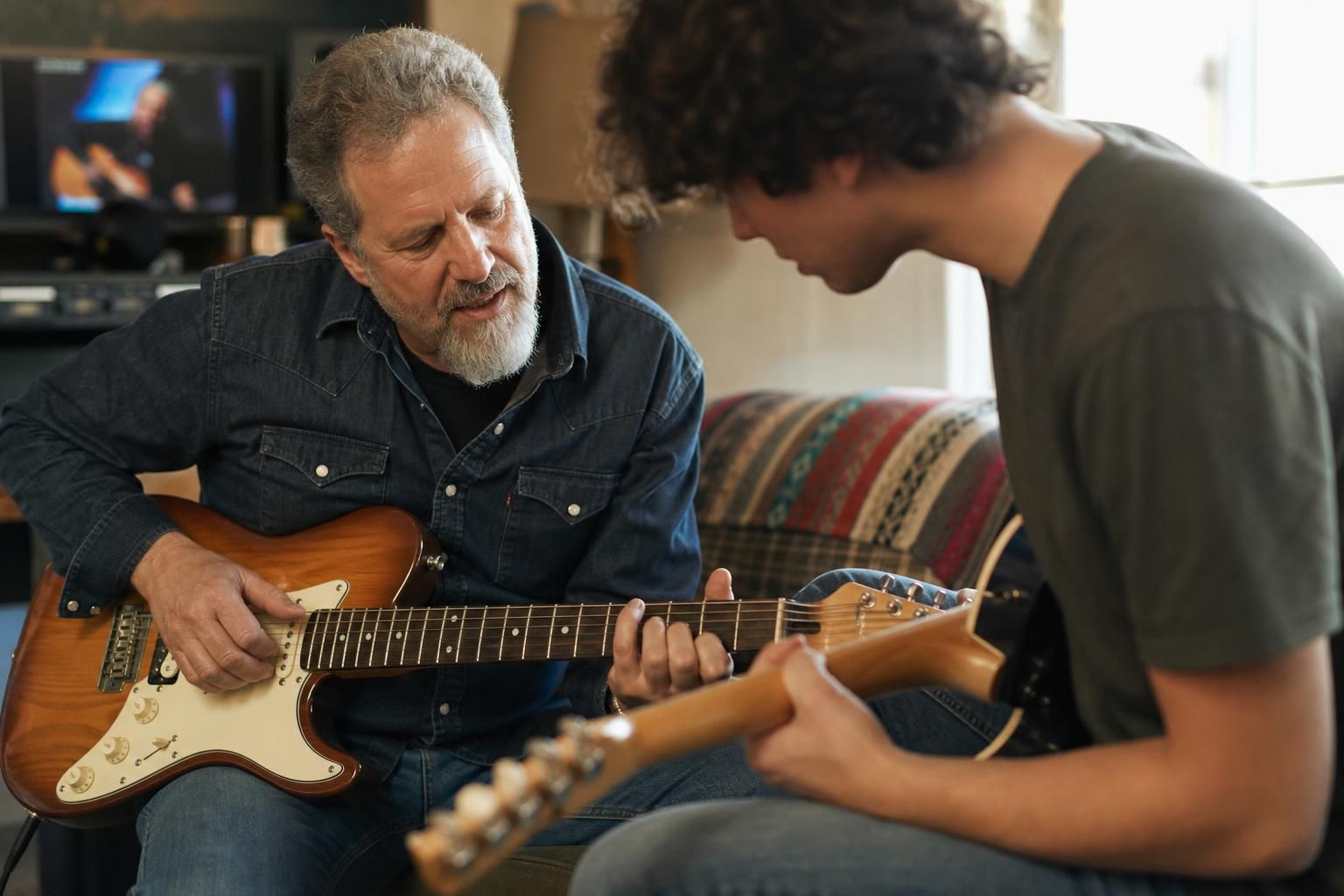
Short answer: the best lesson format is the one that gets you improvising over real chord changes, with feedback, several times a week. For a player with years behind them, that usually means a structured system for connecting the fretboard, plus disciplined practice with backing tracks. Format matters less than whether it fixes your specific bottleneck.
The main guitar lesson formats, compared
These are general trade-offs, not verdicts on any one product. Prices and terms vary widely, so check them directly with any provider.
| Format | Where it's strong | Where it's weak | Best for |
|---|---|---|---|
| In-person private lessons | Real-time correction of technique and phrasing; tailored to you | Usually the highest cost per hour; quality depends on the teacher; fixed schedule | Players who need accountability and a second set of ears |
| Live online 1:1 lessons | Feedback without travel; easy to record and review | Audio latency and video quality can limit playing together; still pay per session | Targeted problem-solving |
| Structured video courses | A set sequence; self-paced; rewatchable | No personal feedback unless the course adds it; easy to watch without practicing | Self-directed players who want a roadmap |
| Workbooks / PDF guides | Dense, scannable, cheap to revisit; good for fretboard maps and exercises | Can't show feel, tone, or articulation on their own | Players who already hear well and need organization |
| Free video platforms | Huge variety at no cost | No sequence; easy to hop between conflicting ideas | Filling gaps, trying out ideas |
| Backing-track practice | The closest thing to real soloing, because you play against changes | Teaches nothing by itself; you can repeat the same licks forever | Anyone, as a supplement to any format above |
The formats aren't exclusive. A system for what to learn and a routine for how to apply it often work better together than either alone.
Why years of playing doesn't guarantee free soloing
Plenty of experienced players still sound like they're reciting. The causes are usually the same few:
- Box-bound playing. You know one or two pentatonic positions well and the rest of the neck is fog.
- Scales without targets. You can play notes that are "in the key" but can't land on the notes that define the chord underneath.
- Lick dependence. Your vocabulary is a set of memorized phrases, so every solo is a remix of the same material.
- Ear and hand disconnect. You hear a line in your head but can't find it fast enough on the instrument.
- Practicing in one key. Everything works in A minor; move to F♯ minor and it falls apart.
Identify which of these is yours before you spend money or time on anything. A course aimed at fretboard mapping won't fix a phrasing problem.
How to solo freely: a practical framework
- Pick one key and one sound. Choose a simple progression, such as a minor blues or a two-chord vamp, and stay with it for a week. Depth beats variety here.
- Map the neck in connected pieces. Learn how your familiar shape links to its neighbors, so you can move up and down the neck instead of sitting in one box. Pick a small set of repeatable patterns and learn how they chain together.
- Know your chord tones. Find the root, third, and fifth of each chord in every position you use. When the chord changes, aim for the new third. That one habit makes solos sound intentional.
- Limit yourself on purpose. Try three notes, one string, or one rhythmic idea. Constraints force you to phrase rather than run scales.
- Sing or hum first. If you can sing a phrase, you can learn to find it. This closes the gap between ear and hand faster than another scale drill.
- Record yourself and listen back. You'll hear repetition and rushed timing that you miss while playing.
- Change keys. Once a pattern feels natural in one key, move it. That's what turns a memorized shape into a usable skill. Our guide on how to practice soloing with backing tracks in multiple keys lays out a routine for this.
Keep sessions short and relaxed. If you feel pain (as opposed to normal fingertip fatigue) in your hands, wrists, or forearms, stop and consult a medical professional or a qualified teacher about your technique.
Do you need music theory?
Less than most people fear, but not zero. You need a working vocabulary: what a key is, what chord tones are, how scale positions relate to chords. You don't need to read notation or analyze classical harmony. We cover this in more detail in Can I learn to solo on guitar without knowing music theory?
Can a workbook replace video lessons?
For some players, partly. A workbook is good at laying out patterns and exercises, but it can't demonstrate feel, vibrato, or timing. If you already have decent ears, a book plus backing tracks may be enough. If you learn by watching and imitating, you'll probably want video too. See Can a workbook or PDF guide teach you to solo without video lessons? for the full breakdown.
Where Adam Loves Guitar fits
Adam Loves Guitar is an online program aimed at helping guitarists solo, built around what its official materials call the Nucleus Patterns Method. We haven't used it ourselves, so we won't describe how it feels to work through or promise any outcome. What we can do is point you to the public information and help you compare it against the formats above.
Before you decide, read these in order:
- What's Inside the Nucleus Patterns Method: what the program says it covers, based on the official page.
- Adam Loves Guitar Reviews, Complaints & Trust: what public feedback says, and how to weigh it.
- Adam Loves Guitar vs Alternatives: how it stacks up against other lesson routes.
- Buying Adam Loves Guitar: Price, Discounts & Refunds: what to check before purchasing.
Prices, bonuses, access terms, and refund policies change. Always confirm current details on the official site before you buy, and read the refund terms yourself rather than relying on a third-party summary, including ours.
How to choose, in five questions
- What's my bottleneck? Fretboard knowledge, phrasing, ear, or consistency? Match the format to it.
- Do I need feedback or just structure? If feedback, a teacher is hard to replace. If structure, a course or workbook may do.
- Will I actually practice with it? The best material is the kind you open daily.
- What are the real terms? Check the price, access length, and refund policy on the seller's own page.
- Is the claim verifiable? Be wary of any promise about how fast you'll improve. Nobody can guarantee that.
- What's Inside the Nucleus Patterns Method
- Adam Loves Guitar Reviews, Complaints & Trust
- Adam Loves Guitar vs Alternatives
- Buying Adam Loves Guitar: Price, Discounts & Refunds
- Can I learn to solo on guitar without knowing music theory?
- Can a workbook or PDF guide teach you to solo without video lessons?
All supporting guides and answers
Product guides
Practice guide
Quick answers
For more from us, head back to the Lead Line Lab home page.
In this section
Most guitarists who have played for years can solo in one or two keys without thinking. Move to F# minor or B…
Read AnswerCan I learn to solo on guitar without knowing music theory?Yes, you can learn to solo without formal music theory, and plenty of players do it by ear and by feel. But a…
Read AnswerCan a workbook or PDF guide teach you to solo without video lessons?Yes, partly. A workbook or PDF guide can teach you the raw material of soloing: scales, arpeggios, licks, and…
Read